Should You Plant Trees or Shrubs Near Your Drain Field This Fall?
Fall is the best planting season in Green Country, and that is exactly why this question comes up every year around Inola, Claremore, and Owasso. Cooler air, warm soil, and steady autumn moisture give new trees and shrubs a long head start before summer heat returns. The problem is that those same conditions push roots outward fast, and a septic drain field is the most attractive target on your entire property. Roots do not respect property lines, mulch beds, or good intentions. They follow water, oxygen, and nutrients, and a drain field delivers all three in a steady supply. Planting the wrong species in the wrong spot this October can cost you a full lateral replacement in three to five years. The good news is that smart fall landscaping and a healthy septic system can coexist on the same lot. You just have to know where the lines are, how far roots travel, and which plants belong nowhere near your treatment area.
How Tree and Shrub Roots Damage a Septic Drain Field
A drain field is not a solid pipe system. It is a network of perforated laterals set in gravel or chambers, designed to release treated effluent slowly into the soil so bacteria and oxygen can finish the job. Every one of those perforations is an open door. Roots find those openings, slip inside, and then expand as they mature, which turns a small intrusion into a solid blockage. Once a lateral plugs, effluent backs up toward the tank and the house, and the surrounding soil loses its ability to absorb. Oklahoma clay makes this worse because water already moves slowly through it, so any added restriction shows up fast. Homeowners often blame the tank when the real failure sits twenty feet away under the lawn. Understanding the mechanics helps you plant with confidence instead of guessing.
Why Tree Roots Target a Septic Drain Field
Roots grow where conditions favor them, and they are remarkably efficient at finding the best real estate on a property. A drain field offers consistently moist soil, dissolved nitrogen and phosphorus, and loose backfill that is easier to penetrate than compacted native ground. During a dry Oklahoma August, your drain field may be the only reliably damp zone on an acre of parched clay. Trees respond by sending feeder roots in that direction and thickening them over time. This is not random. It is a measurable growth response, and it is why arborists warn homeowners about planting near any subsurface water source. The same principle applies to water lines, downspout discharge points, and low areas that hold runoff.
Root spread is far wider than most people expect. A common assumption is that roots stay inside the canopy drip line, but the majority of a mature tree’s root mass extends two to three times the width of its branches. A silver maple with a thirty foot canopy can easily send roots sixty to ninety feet in every direction. Depth is less of a factor than distance, since most active roots sit in the top twelve to twenty four inches of soil, which is exactly where drain field laterals live. That overlap is what causes trouble. A sapling planted twenty feet from your laterals this fall is not a threat today. In six years it absolutely will be, and by then the damage is already underway.
Shrubs deserve the same scrutiny, even though they look harmless in a nursery pot. Many popular landscape shrubs sold across Rogers and Tulsa counties have dense, fibrous root systems that mat together and choke gravel beds. Others send out surprisingly long lateral runners in search of moisture. Bamboo, privet, and large juniper varieties are frequent offenders. Even ornamental grasses planted in tight clusters can hold excess moisture at the surface and interfere with evaporation from the field. The safest approach treats shrubs as small trees rather than as decorations. Give them real distance, and put the low maintenance plantings closer to the house where they belong.
The Worst Trees and Shrubs to Plant Near a Drain Field
Certain species are so aggressive that no reasonable setback makes them safe on a standard residential lot. Willows top the list, followed closely by cottonwood, silver maple, poplar, elm, and sycamore. Sweetgum, river birch, and aspen are also known for fast, water seeking growth. These trees evolved along creek bottoms and floodplains, so moisture detection is built into how they survive. Northeast Oklahoma has plenty of them growing wild along the Verdigris and Grand River corridors, and homeowners often transplant volunteers without thinking about the consequences. If any of these already stand within one hundred feet of your laterals, you are on borrowed time. Removal is usually cheaper than a replacement drain field.
Fruit and nut trees create a second category of risk that has nothing to do with roots alone. Pecans, which grow beautifully across this part of the state, develop enormous root systems and live for decades. Beyond the mechanical damage, food producing plants near a drain field raise a genuine sanitation concern. Effluent moving through soil still carries bacteria and viruses until treatment finishes, and root uptake creates a pathway you do not want in your kitchen. Health guidance across the country consistently advises against vegetable gardens and fruit plantings over or beside an absorption area. That includes raised beds, since the soil below them is still part of the treatment zone. Put the orchard on the opposite side of the house.
Evergreen screens are the mistake we see most often on rural properties. A homeowner wants privacy from the road or a windbreak on the north side, so they plant a tight row of Leyland cypress, eastern red cedar, or arborvitae. Those rows almost always run along a property line or driveway, and drain fields frequently sit in that same open ground because it is the flattest available space. Within a decade the roots are fully into the gravel. Bald cypress is another poor choice despite its popularity, since it thrives in saturated conditions by design. If you want a screen, measure first and shift the line. Need help finding exactly where your laterals run before you dig? Click here for our septic drain field service.
Warning Signs of Root Damage in a Septic Drain Field
Root intrusion rarely announces itself with a dramatic failure. It builds quietly for years while the system compensates, then fails during a wet spell or a holiday weekend with a full house. The earliest indicator is usually a change in how fixtures drain. Toilets flush a little slower, tubs gurgle, and the washing machine cycle backs up when it discharges a large volume at once. Many homeowners treat those symptoms as a plumbing issue and snake the house line with no lasting improvement. Pay attention to timing instead. Problems that worsen after heavy rain point toward the field, not the fixture.
Surface clues are just as reliable once you know what to look for. Strips of unusually dark green, fast growing grass directly above the laterals mean effluent is sitting too close to the surface. Standing water, spongy ground, or a persistent sewer odor over the field confirms it. In cooler months you may notice snow or frost melting in lines across the yard while the rest of the lawn stays white. Some homeowners see the opposite pattern, where a lateral has plugged completely and the grass above it browns out during summer because it no longer receives moisture. Any distinct striping in your lawn deserves an inspection. Those lines mark your laterals, and they are telling you how each one is performing.
Inside the tank, evidence shows up in the effluent level. A properly working system holds liquid at the base of the outlet baffle, so a level noticeably above that point means the field is not accepting flow at the design rate. Pumping the tank will temporarily relieve the backup, but the level climbs again within weeks because the actual restriction is downstream. This is why repeat pumping without a field evaluation wastes money. On aerobic systems with spray heads, watch for weak or uneven spray patterns and for shrub growth blocking the heads. Oklahoma DEQ requires those systems to disperse effluent as designed, and overgrown landscaping interferes with that. A trained technician can distinguish root intrusion from biomat failure, hydraulic overload, and pump problems in a single visit.
Safe Fall Planting Distances and Landscaping Near a Septic Drain Field
You do not have to give up landscaping to protect your septic system. You have to plan around a zone that most properties can easily accommodate. The first step is knowing precisely where your tank, laterals, and reserve area sit, since guessing is how homeowners end up trenching through a lateral with an auger. As built drawings from the original permit, county records, or a professional locate will give you accurate boundaries. Once you have that map, setback decisions become simple arithmetic rather than guesswork. Fall planting then becomes a low risk project instead of a gamble. The rules below apply across Inola, Catoosa, Coweta, Bixby, and the rest of our service area, and they hold up in the clay soils common throughout the region.
Setback Distances for Planting Near a Septic Drain Field
The most practical rule of thumb sets the minimum distance equal to the mature height of the tree, measured from the nearest edge of the drain field. A tree expected to reach forty feet goes at least forty feet away. For aggressive, water seeking species, double that number or eliminate them from consideration entirely. Small ornamental trees such as redbud, crape myrtle, or dogwood can sit closer, though thirty feet remains a sensible floor. Always measure from the outer laterals, not from the center of the field, and include the reserve area in your calculation. That reserve ground is set aside by permit for a future replacement field. Building or planting over it can leave you without a legal option later.
Shrubs follow a scaled version of the same logic. Compact varieties that top out at three or four feet can generally be placed fifteen to twenty feet from the laterals with minimal risk. Larger shrubs that reach eight feet or more need thirty feet or better. Keep in mind that shrubs planted in a continuous hedge behave more like a single large plant than a series of small ones, since their root systems merge underground. Consider mature size rather than nursery size, and check the tag before you buy. A one gallon pot tells you nothing about what the plant becomes in eight years. Spacing decisions made in October determine repair bills a decade out.
Root barriers offer a workable compromise when space is genuinely tight. These are rigid panels, typically high density polyethylene, installed vertically in a trench between the planting and the drain field. Effective installations run at least twenty four to thirty six inches deep and extend well past the edges of the area being protected, since roots will simply travel around a barrier that is too short. Barriers redirect growth downward and sideways rather than stopping it, so they reduce risk without eliminating it. They also require careful installation to avoid cutting existing laterals during the trenching work. This is not a weekend project to attempt with a rented trencher near a septic system. Have the field located and marked first, then let a qualified crew handle the excavation.
Safe Plants and Ground Cover for a Septic Drain Field
Turfgrass remains the single best cover for a drain field, and it is not a compromise choice. Grass roots stay shallow, hold soil in place, and pull large volumes of moisture out of the ground through evapotranspiration, which directly assists the treatment process. Bermuda and fescue both perform well across northeast Oklahoma and establish readily in fall. Mow it, keep it healthy, and resist the urge to improve on it with heavy landscaping. A drain field covered in good grass is doing exactly what the designer intended. It also stays easy to inspect, since problems show up visually in the turf. That early warning is worth more than any ornamental bed.
Shallow rooted herbaceous plants make a reasonable second option for homeowners who want more visual interest. Native wildflowers, prairie perennials, and low growing groundcovers work because they die back or stay small and never develop woody root structures. Options like little bluestem, black eyed Susan, purple coneflower, and creeping thyme all fit the profile and handle Oklahoma summers without supplemental irrigation. That last point matters more than most people realize. Any planting that requires regular watering adds hydraulic load to a field already sized for a specific daily volume. Choose drought tolerant species so the field never receives water it was not designed to process.
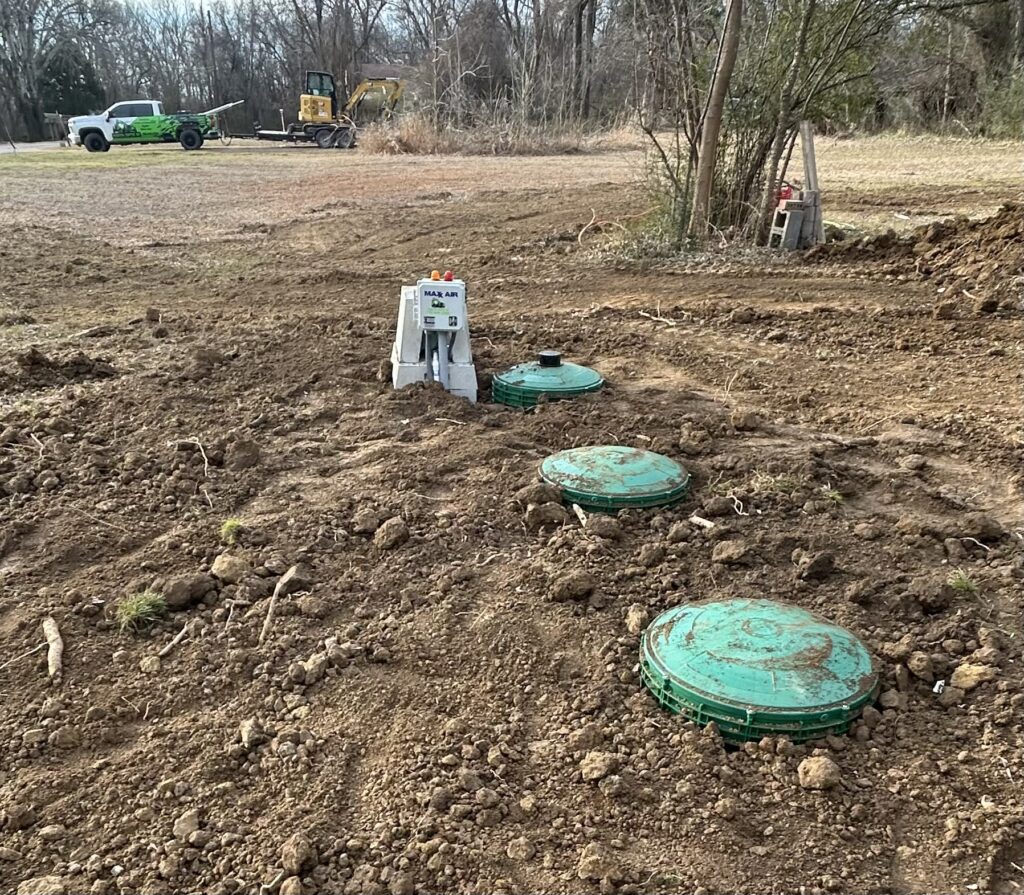
Placement within the field area still requires judgment. Keep all plantings clear of tank lids, cleanouts, and inspection ports so service access stays open. On aerobic systems, maintain generous clearance around spray heads and control panels. Avoid planting directly over the distribution box, since that component often needs adjustment or repair. Leave a mowable path across the field for equipment access, because a pump truck or excavator may eventually need to reach the area. Landscaping that traps a service crew adds cost to every future visit. Planning access into your design costs nothing today and saves real money later.
Fall Landscaping Mistakes That Ruin a Septic Drain Field
Adding soil on top of a drain field is one of the fastest ways to kill it, and fall is when homeowners are most tempted to do it. Grading projects, new flower beds, and topdressing all reduce oxygen exchange between the soil and the atmosphere. Aerobic bacteria in the upper soil layer need that oxygen to finish treating effluent, and burying the field under six inches of fill starves them. The same goes for thick mulch layers and any form of plastic sheeting or landscape fabric. Rock beds create an additional problem by increasing surface temperature and shedding water unevenly. Keep the original grade and the original cover intact.
Compaction ranks a close second among preventable mistakes. Driving a truck, trailer, skid steer, or loaded utility vehicle across a drain field crushes the soil structure that makes absorption possible, and clay soils never fully recover. Fall projects bring extra traffic onto lawns, from firewood deliveries to landscaping equipment to holiday parking. Mark the field boundaries before any of that starts. Do not build sheds, patios, decks, above ground pools, or driveways over the area, since those are permanent forms of the same damage. Livestock create a similar issue on acreage properties, so fencing the field is worth considering.
Irrigation planning deserves attention before you install anything this fall. Sprinkler systems routed across a drain field deliver water the system never accounted for, which saturates the soil and reduces its capacity to accept effluent. Downspout extensions, French drains, and sump pump discharge lines should all be directed well away from the absorption area. Grade the surrounding ground so surface runoff sheds around the field instead of across it. Homeowners in low lying areas near Wagoner and Pryor Creek deal with this constantly during wet seasons. Getting drainage right protects the field far more than any product you can pour down a drain. Planning to pump the tank before the holidays? Click here for our septic pumping service.
Why You Need a Professional Drain Field Inspection Before You Plant This Fall
Landscaping decisions are permanent in a way that most home projects are not. A tree planted in the wrong place this month cannot be undone in five years without removing a mature specimen and possibly rebuilding your drain field at the same time. A professional inspection removes the guesswork by confirming exactly where your components sit and how well they are working right now. It also catches early root intrusion while corrective work is still affordable. Martin Septic is DEQ certified for aerobic and conventional systems, and we provide free, no obligation estimates on every job. Getting an accurate picture before you plant is the cheapest step in the entire process.
What a Professional Drain Field Inspection Covers
A thorough drain field inspection starts with locating and mapping the full system, including the tank, distribution box, laterals, and reserve area. We mark those boundaries so you can plan landscaping around real measurements instead of assumptions. Next comes an evaluation of effluent levels in the tank and, where accessible, at the distribution box, which reveals how the field is accepting flow. Surface conditions across the absorption area get checked for saturation, odor, settling, and vegetation patterns that indicate trouble. On aerobic systems, we verify aerator function, spray head coverage, and control panel operation. Each finding gets explained in plain terms so you know what you are dealing with.
When symptoms suggest root intrusion, the inspection goes further. Camera work and mechanical clearing can confirm which laterals are affected and how far the intrusion extends. Partial blockages caught early often respond to cleaning and targeted repair rather than full replacement. We do not recommend dumping chemical root killers into a septic tank, since products like copper sulfate damage the bacterial population the system depends on to function. The correct fix addresses the source, which usually means removing the offending tree along with mechanical restoration of the affected lines. Cutting corners here produces a repeat failure within a year or two.
Documentation is the part homeowners appreciate most later. A written record of your system layout, component condition, and service history makes every future decision easier, from landscaping to selling the property. Buyers and lenders frequently request septic records during real estate transactions in Rogers, Wagoner, and Tulsa counties. Having current information ready prevents delays at closing. It also helps you track how the system performs over time, which makes early problems easier to spot. Good records turn septic ownership into routine maintenance instead of recurring emergencies.

When to Schedule a Drain Field Inspection This Fall
Schedule the inspection before you buy plants, not after. Nursery stock is at its best in fall, and it is tempting to bring home a truckload and start digging the same afternoon. Knowing your setbacks first lets you shop with a plan and avoid returning plants that will not fit safely on your lot. Early fall also gives you time to complete any needed repairs while the ground is workable and temperatures are mild. Waiting until winter means frozen or saturated soil and higher costs on excavation work. A short appointment now prevents a long project later.
Fall is also the right window for routine pumping on most residential systems. Household water use climbs during the holidays when guests visit and laundry loads multiply, and a tank near capacity has no reserve for that spike. Pumping before Thanksgiving removes accumulated solids and protects the drain field from carryover, which is a leading cause of premature lateral failure. Most families need service every three to five years depending on tank size and occupancy. Aerobic systems require regular professional maintenance on a set schedule under DEQ rules. Combining pumping with a field evaluation makes efficient use of one visit.
Certain warning signs mean you should call immediately rather than waiting for a convenient date. Sewage backing up into fixtures, standing water over the field, or strong odors near the tank all indicate active failure. The same applies to alarms on aerobic system control panels. Delaying service in those situations raises the risk of contaminating groundwater and expands the scope of eventual repairs. We offer emergency septic service day or night for exactly these situations. Fast response keeps a bad day from becoming a full system replacement.
Why Choose Martin Septic for Drain Field Service in Oklahoma
Martin Septic has built its reputation on full service septic solutions with no shortcuts. Our crews are professionally trained and honest, and we explain what we find without inflating the scope of work. We are DEQ certified for aerobic and conventional septic systems, and we are a member of the Tulsa Home Builders Association. That combination matters because septic work spans new installation, design, repair, and long term maintenance, and every stage affects the next. Working with one company across all of it keeps your system consistent and your records complete. Homeowners across Inola, Claremore, Catoosa, Owasso, Collinsville, Broken Arrow, Jenks, and Tulsa rely on us for that continuity.
We handle every part of the process, from septic design and engineering through installation, pumping, repair, and water line work. That means we can locate and map your existing field, correct root damage, replace failed laterals, or design a new system when the old one has reached the end of its life. Free, no obligation estimates apply to all of it, so you always know the cost before work begins. Our familiarity with local soils, county requirements, and DEQ standards keeps projects moving without surprises. Northeast Oklahoma clay behaves differently than soil elsewhere, and experience with it matters. We size and service systems for the conditions that actually exist on your property.
Fall landscaping should improve your property, not create a repair bill you will be paying off in a few years. Get your drain field located and evaluated first, choose plants with mature size in mind, and keep aggressive species far away from your laterals. If you already suspect root intrusion or you are seeing wet spots and slow drains, do not wait for the problem to spread. Click here for our septic repair service to get started, or reach out and we will walk you through your options. Call Martin Septic at (918) 640-2298 or email info@martinsepticok.com to schedule your free estimate before planting season gets away from you.